Common Questions on SF-1 and SF-2 Bushing Performance
Q: What are the primary differences in material composition between SF-1 and SF-2 bushings?
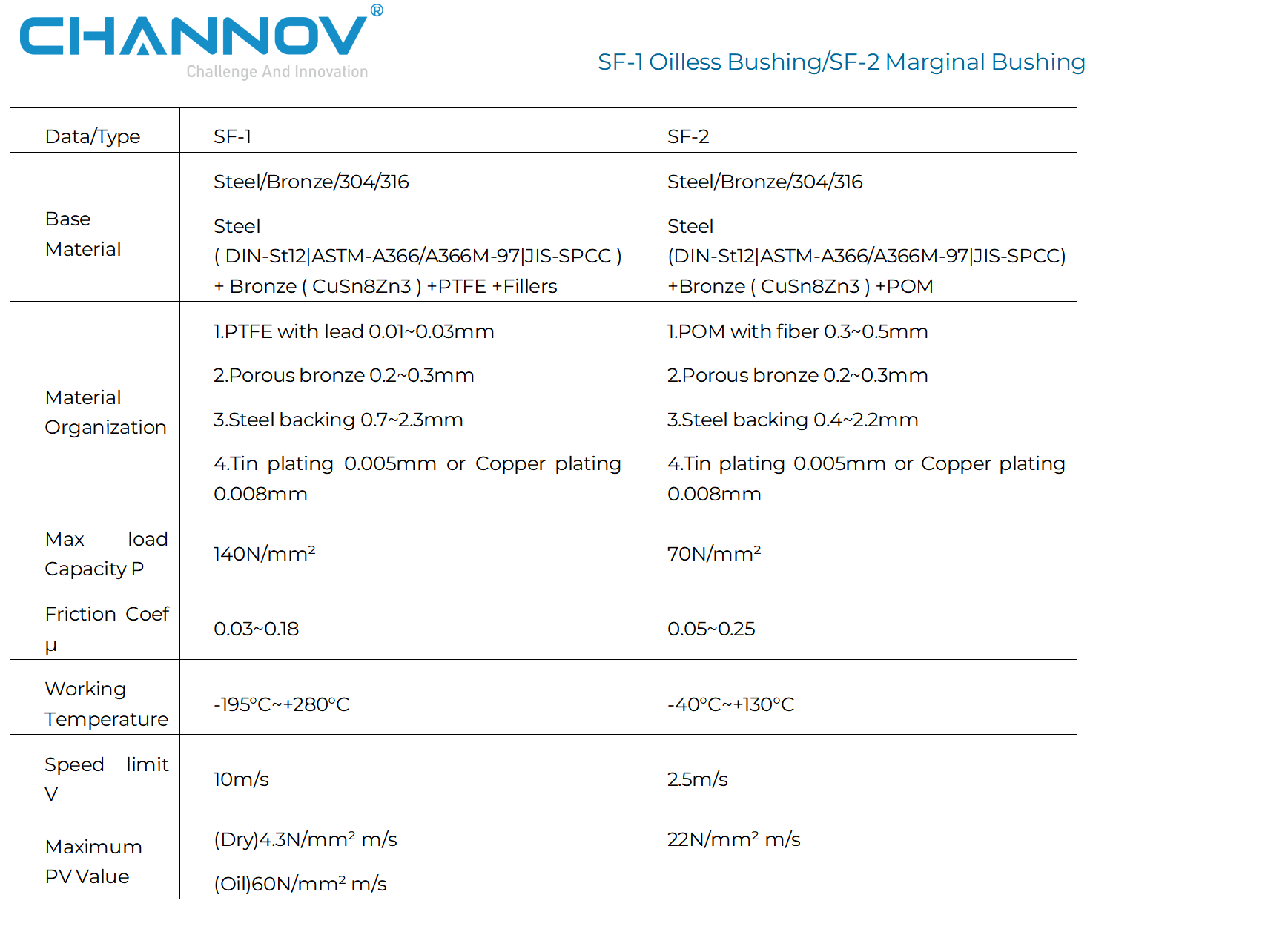
A: Both bushings use a base of Steel/Bronze/304/316 with a porous bronze interlayer. However, the top sliding layer differs: SF-1 features a PTFE with lead layer (0.01-0.03mm) for dry running,
while SF-2 utilizes a thicker POM with fiber layer (0.3-0.5mm) designed for marginal lubrication.
Q: Which bushing type offers higher load capacity and a wider operating temperature range?
A: SF-1 oilless bushings offer a maximum load capacity of 140N/mm2 and a working temperature range of -195°C to +280°C.
In contrast, SF-2 supports up to 70N/mm2 and operates between -40°C and +130°C.
Q: How do the sliding speed limits and friction coefficients compare?
A: SF-1 is better suited for higher speed applications with a limit of 10m/s and a lower friction coefficient of 0.03-0.18.
SF-2 has a speed limit of 2.5m/s and a friction coefficient of 0.05-0.25.
Q: What is the Maximum PV Value for SF-1 bushings?
A: For SF-1, the Maximum PV Value is 4.3N/mm2 * m/s under dry conditions and increases to 60N/mm2 * m/s with oil lubrication. For SF-2, it is rated at 22N/mm2 * m/s.